Monday, January 28, 2013

"Psycho" Hitchcock- Genre And Audience


1. What tradition or genre is it in?

Psycho categorizes as a horror film. "Horror", however, is a broad category. If one were to further categorize it and give it a more specific genre, Psycho could be called a "psychological horror" or "psychological thriller". This is important because it is believed to be the film that coined the genre itself. There had been generic horror films prior, but Psycho took the genre to a new level, a level that made the audience wonder.

2. What are the features determining genre or elements that tell us what type of film this is?
There are many aspects of the film that point out its genre. One major key is the musical score. Pycho has a chilling even intense soundtrack. High pitched screeches and dark ambiance are often preset in the background, adding a spooky feel to the movie. Setting also plays a major part. Use of setting and lighting are also important aspects. Dark, highly shadowed areas are seen throughout the film supplying the audience with a mysterious feel.


3. What other work might it be connected to?
The movie itself was based after the novel Psycho, which was written in 1958. Similar characters and plot were used and a great deal of inspiration came from it.


4. Who made this? Why?
Filmmaker Alfred Hitchcock, curated and directed this movie. He was a popular filmmaker at the time and had been know to steer away from the ordinary. It brings no surprise that he would be the one to make a movie like Psycho.


5. What can we tell about its’ creators?
We can tell that Hitchcock and his team were, in a way, rather twisted. They were twisted in an artistic sense, however. They strove to stay away from social norms and challenged what was acceptable at the time. They brought great shock to the public with the unveiling of this film but in a sense brought the film industry into a revolution.


 6. How does it fit within the director’s other work?
 a. Does it share significant narrative or thematic concerns?

 b. Does it share particular visual or technical elements?
Alfred Hitchcock had been known for his maniacal and dark films. Like I said before, it wasnt surprising that Hitchcock happened to be the one to make the first "Psycho-like" film. Her was always pushing the boundaries on what was acceptable and luckily, this worked as an advantage to him. Although the film takes the genre to a new level, Pycho is very similar in genre and narrative to Hitchcock's other films and conveys similar themes. It shares similar visual elements and incorporates Hitchcock's iconic style.


7. What is the film’s theme?
The film Psycho coveys a theme related to mystery. It shows and follows the "Unconventional Killer". Previously, most villians in the film world were obvious and, in a way, over-exaggerated. It was always too easy to tell who the "bad guy" was. Psycho took a different route, and made a character like Norman Bates the villain. This gave the message that villians were hiding in broad daylight. It showed that terror and evil can come from the unsuspected and that no one can be truly sure if they are safe.


8. What is the target audience? How does it address its audience?
I believe Hitchcock's target audience was everyone. He wanted the whole world to see the film and understand the message he was delivering, as well as enjoy the presentation he was going to give. Some young children may be excluded from this, but Hitchcock wanted the masses to see this change of scenery he had created.



Monday, January 14, 2013

From Silents to Studio' Golden Years pt. 2

The years between 1930 and 1950 are widely known as the "Studio Years" in the film world. Sound was beginning to be incorporated into motion pictures and the film industry was experiencing a revolution. Many great advancements came from this, but there were negative sides as well. New inventions that would affect the industry seemed to be popping up everywhere. It was a time of innovation.


One major shift was the start of what were called "Studios" These elaborate storehouses were used to film and produce various movies. Fake sets started appearing and settings shifted from real places to fictional illusions. This made the filming more efficient and only whats needed was used in the sets. Sound was also more easily captured in the warehouses. This was beneficial the the producers but not to the stars. With the efficiency of sets, actors could now do work for various films simultaneously. This exhausted actors and greatly increased their work schedules. Contracts also started forming and actors and actresses started to become property of certain studios. Since production organization increased, so did exposition organization. Theaters grew tremendously in size. We saw shifts from small 20-30 seat nickelodeons, to lavish large sized auditoriums. Theaters were sprouting one after another and just kept coming.


Since actors and actresses started regularly appearing in films, the star system emerged. Regular celebrities began to enter into society and become widely popular. This however came double edged. As we know not everyone is perfect, and as these actors became publicized, we we reassured of that. Many scandals emerged between actors and actresses. In one major scandal, Actor "Fatty" Arbuckle was convicted for murder. Although the charges were eventually dropped the publicity ruined Arbuckle's career.

Hollywood soon found out, however; that sin can sell. The industry began making more risque film and the industry soon took a turn in a new direction. Questionable movies sold and it was a proven fact. Studios started creating films that included more provocative material and the battle of "Money vs Moral" emerged.


From Silents to Studio' The Golden Years pt. 1


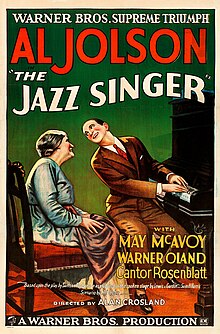
In 1927, Warner Bros. presented the first feature-length film to include sound, The Jazz Singer. Although the film was mostly music and incorporated only 354 spoken words, it was enough to start a buzz. Sound was swiftly sweeping into the film culture and the industry would see a change unlike any other.

     
Sound was actually available to the film world in the mid 20's but before The Jazz Singer, it wasn't accepted with open arms. Filmmakers feared sound for a variety of reasons. For one, they weren't sure the public would enjoy it. Many actors in silent films were foreign as well, and had heavy accents. Adding to that, a fair amount of actors had weak voices and just weren't vocally trained. Another reason they were hesitant was cost. Building sound studios wouldn't be cheap.


       Warner Bros., in a desperate attempt not to fall out of the industry, decided to experiment with sound in their motion pictures. They agreed that they had nothing to lose and were willing to take a risk. Through this, The Jazz Singer was born. It was a hit and other film companies soon caught on. In no time sound was included throughout the industry.

This was dream come true, at least, for some it was. Many actors dreaded this shift. A large amount of actors in the business had voices that just worthy of film. Some took vocal lessons but many performers lost their jobs due to this shift.

The value of production was also believed to be affected by this change. Cameras had to be fitted with sound boxes to preserve the audio and keep it crisp. These refrigerator sized boxes greatly limited the movement of the camera. motion shots and complex shots started to disappear and some of the great cinematic gems of film disappeared.

More info at: http://cybercollege.com/frtv/frtv003.htm

Writing About Film


There are five basic styles for writing about film. This post will explain the following styles.

Formal Analysis: In this style, the writer needs to ponder and analyze every aspect and element of the film as one. The writer needs to view the film as a whole. Writers focus on the films total impact and its deeper meanings.

Film Knowledge: The author of this form of writing needs to have a vast understanding of film and its roots. Writers focus on the films lasting impact and the effect it will give in the future. It focuses on the genre and its cultural reletivity.

Ideological Paper: This form of writing reflects the ideals and beliefs expressed throughout the production. This form of writing can inspect items varying from personal morals to government propaganda.

Cultural Studies and National Cinemas: This style focuses on the effects a certain culture has on a film, portrayed unintentionally. This style varies dependent on the differing cultures

Discussions of the Auteur: The "Auteur" refers to the director and how his personal visions  and creativity play a part in the film. This style focuses on what makes the film the director's own film, or how the director has influenced the final product. This style sort of pools from other styles and brings them together.

What is "Annotating a Shot Sequence"

Annotating a shot sequence, is when an individual takes notes and comments on each and every shot. Each annotation discusses the shots and mainly WHY they appear the way they do. They discuss what the director was tying to convey and the reasons behind the placement of the shots.

"Thinking Beyond The Frame"

With this concept, we are urged to think and ponder sequences and scenes in a production. Similar to the phrase "Think outside of the box", The author is urging us to find a deeper meaning in the shots and to consider the true meaning. You are urged to find a second or hidden meaning. For example, lets say a character in a film is coming down with a cold. We may just take it as an unfortunate event when, however; it symbolizes the downturn in his life and lack of a purpose.


Thursday, December 6, 2012

Limitless: Trailer Review


Things that make this trailer successful:

1. Narrative: This trailer is very fast paced. It gets the viewer exited and focused. It uses many quick shots and transitions in order to catch the viewers attention and keep them interested. It uses dialogue to convey the plot. It does it in a way that tells you a bit about the story line but doesn't spoil anything. This is very important when creating a trailer. You don't want the viewer knowing the whole plot but you also don't want them confused over the storyline. This is key in a trailer and Limitless's sure pulls it off.


2. Mis en Scene (or Setting):
This trailer gives great use of setting. It shows different locations, from urban slums to tropical islands. The trailer contains scenes in office buildings to night clubs. The use of setting draws the viewer in and shows them the nature of the film and where it takes place. using interesting settings such as a lit city or beach gives the viewer a feeling of excitement.


3. Cinematography:
Different styles of cinematography are used throughout this trailer. For example, there is a scene of the main character in his room with a birds eye view from the wall. This kind of camera technique is not commonly used and expresses a warped reality showing us scenes we couldn't see through our own eyes. Shots like that add interest to the trailer and show us that the movie isn't flat. Complex camera angles and techniques draw in viewers and add interest.

4. Edit: Edit is used quite a lot in this trailer as well. In a way the editing compliments the cinematography and conveys messages not as easily sent without it. As an example, while the main character is walking, we see through his eyes in his point of view. We see warping around the buildings and people. This shows a warp in reality hinting that something isn't right or normal. Use of edit can really tie the knot of a trailer. It can really draw in the audience watching it


5. Sound Design: Music was always present in this trailer. it starts out average but follows the plot and soon gets fast paced. As conflict arises it stops for a moment showing the mood of the scene. It then moves onto a piece that is face paced and energetic again (Power - Kanye West). The music helps convey the theme of the piece and helps the audience understand what they are watching.

Fashion: A Changing World, Preproduction.

Purpose: The purpose of this documentary piece is to discover what's new in the world of fashion and design, who the leading competitors are, and predictions for the next season of clothing.
Contact:
In order to get this piece in effect, i will need to contact The Fashion Institute of Design and Media in San FranciscoQuestions:
What role does fashion play in the world today?
What's new and upcoming in the world of fashion?
How are these changes impacting you as a designer?
Who are the designers that are in “the lead”?
Do you have any predictions for what we will be seeing during the spring/summer 2013 season
Shot List:
Shots of the Institute, Runway Footage, Designers at work, Fabrics, Classes Being Taught, Interview Shots, Various B-roll


General Flow:

“Fashion is an ever changing topic, you may think you know what's new, but as soon as you blink that changes. In order to cover some of the trends and fashion movements where better to go than San Francisco’s very own Fashion Institute of Design and Media. “FIDM” for short has around _______ students on their San Francisco campus alone, some of which may grow to be the next big things in the fashion world. We’re going to talk to a few to get their insights and opinions on varying subject related to the fashion world.For Example, What role does fashion play in the world today?”
Person 1 ____________
Person 2 ____________________
Person 3 _____________________

next set of questions follow and the people being interviewed answer them and so on

“We’ve learned a lot about the ever changing world of design. I hope you look forward to watching the world of fashion twist and turn as time goes on”
end
Script:
Start off with quick shots of the city. Then a transfer to various runway shows, as well as the fashion institute. A shot or two of the people being interviewed “Fashion is an ever changing topic, you may think you know what's new, but as soon as you blink that changes. In order to cover some of the trends and fashion movements where better to go than San Francisco’s very own Fashion Institute of Design and Media. “FIDM” for short has around _______ students on their San Francisco campus alone, some of which may grow to be the next big things in the fashion world. We’re going to talk to a few to get their insights and opinions on varying subject related to the fashion world.”
People being interviewed answer and shots correlating to their answers are shown. Cu of students interviewed. For Example, What role does fashion play in the world today?”

People being interviewed answer
People being interviewed answer and shots correlating to their answers are shown. Cu of students interviewed. “What's new and upcoming in the world of fashion?”


People being interviewed answer
People being interviewed answer and shots correlating to their answers are shown. Cu of students interviewed. “How are the changes going to affect you as a designer”
People being interviewed answer
People being interviewed answer and shots correlating to their answers are shown. Cu of students interviewed. Who are the designers that are in “the lead”?
People being interviewed answer
People being interviewed answer and shots correlating to their answers are shown. Cu of students interviewed. Do you have any predictions for what we will be seeing during the spring/summer 2013 season
People being interviewed answer

Production schedule not necessary (using wills concept due to lack of time)

Happy

Figure 1
What does it mean to be “happy”?

Figure 2
Happy is a documentary that aims to answer that very question. What makes one happy and how can we find this emotion most effectively? This purpose of this documentary is to profile many different individuals and find the answer to what makes us happy, and how we can get there. Whether you’re eight or eighty, Happy is the kind of film that will make you reevaluate your lifestyle and how you view the earth. This documentary makes great use of interview and scene location. Location is used throughout the film, and we see shots in unique places. For example, while interviewed about what makes him happy, a Louisianian tour guide is interviewed on the bayou itself rather than in a room. (Figure 2  & 3)

Figure 3

This film focuses on what is really important and each scene has a deep strong message tied to it. There are few “Filler Scene” or scenes used to take up unnecessary time. The documentary Makes great use of Matching Audio and Footage as well. For Example, If a Person is talking about their pet, you can expect to see shot of the pet following the audio. The footage used has deep meaning to it. Going back to the example of the tour guide. We see shots of nature and open space. These shots are used to convey/symbolize freedom of mind and inner happiness. The documentary uses spontaneous interaction as well as scripted interaction. Throughout the film we see transitions being used. One unique transition is in the form of quick interview. Random people on the street were interviewed and asked “What they want in life?” all of them shared the same answer: “To be happy” (Figures 1, 4, and 5)

Figure 4
Figure 5

Not only are random individuals and accounts used for interview, but expert testimonies are used as well. Psychologists are often interviewed in this documentary in order to back up the claims by others. These “experts” give scientific proof to strengthen the points of others. Animation, charts and visuals are also used to show information. Use of narration is present in this film. A Narrator is present throughout the film and gives the audience facts, introduction to characters, and background information during the documentary. This documentary’ s main focus wasn't as much making an argument, as it was informing an audience about a subject. The documentary focused to teach viewers about happiness and how to achieve it.
The camera work on the documentary as a whole was not too major. They used a lot of still shots and handheld shots. Scenes had light pans and focuses but nothing too radical. From a filming perspective it was shot rather safely and this works. The nature of the film did not require intricate camera movements or techniques and worked fine without them.
Overall, I would say that this film was very effective. It taught viewers a lesson that benefited them. Its a documentary that really makes you ponder what you know and how you think. It teaches viewers about being thankful and what they can do to better enrich their lives. After watching this documentary i really did think about how i was living my life. If you’re looking for a documentary that'll make you think and give you that “feel good” attitude, look no further.